Tool · · Peter Hanlon
Audience similarity beyond cross-visitation
Brands are multi-cohort
Audience similarity scores how alike two domain audiences are across 152 behavioural dimensions using cosine similarity, even when those audiences never visit the same sites.
We have unique access to data that lets us understand how similar audiences of different domains are — and whether they share behavioural characteristics — regardless of whether there is cross-visitation. That distinction matters more than people admit.
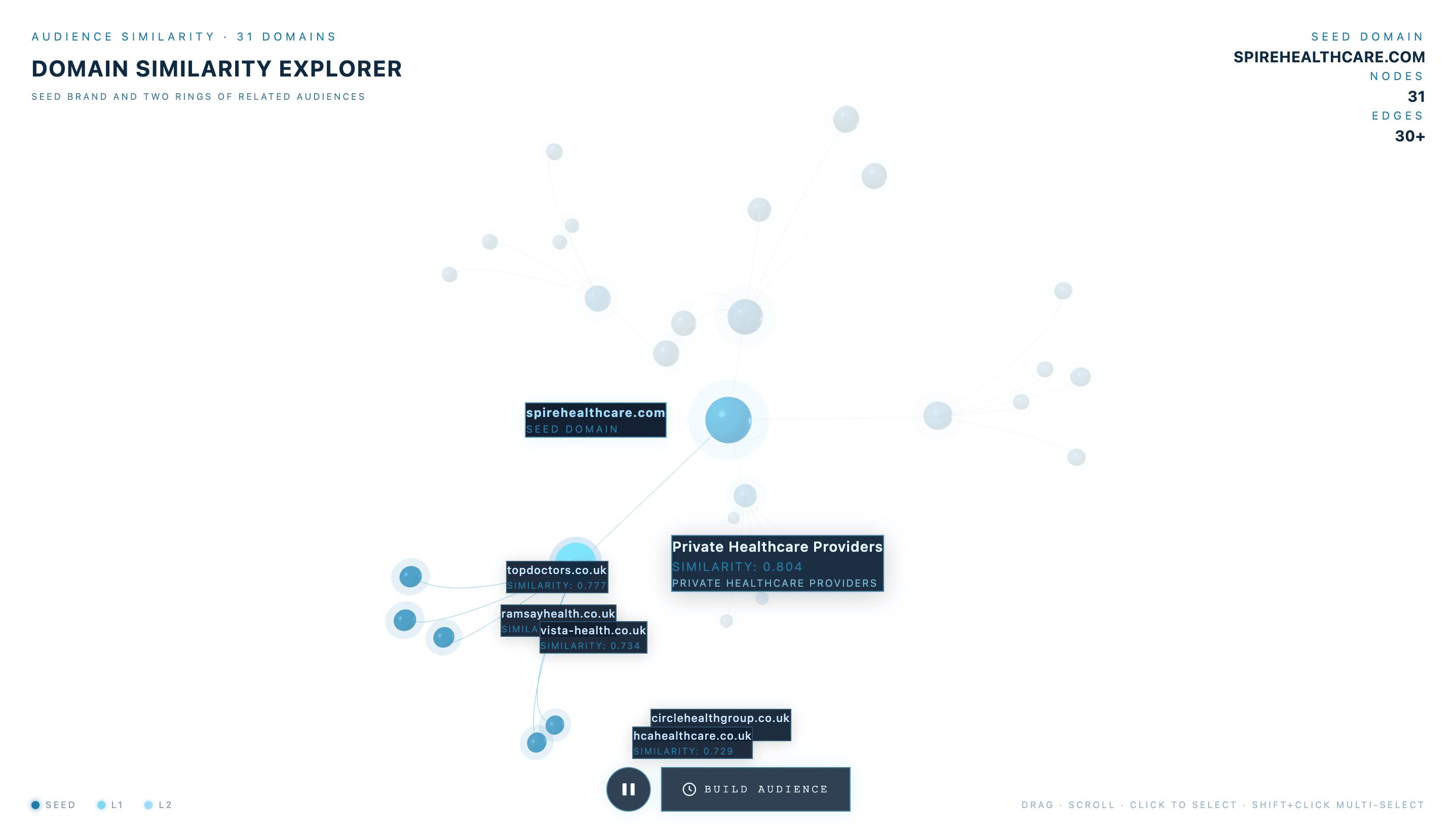
Two places this earns its keep
I keep coming back to it for two jobs. First: understanding that brands are multi-cohort. Second: expanding niche audiences from tiny seed domains without pretending overlap is the only signal.
Brands are multi-cohort
It is easy to fall into the trap of thinking a brand is one set of people. In most domains, visitors are multi-cohort. Chanel is the example I use a lot. Most people assume female, older, affluent, handbags. Fine as a stereotype. Wrong as a brief.
Our data shows Chanel customers do sit with high-end fashion — Hermès, Dior — but also skincare like Clarins and Clinique, and lifestyle brands like Sweaty Betty and Le Creuset. The Atom Model is how we draw that without a 40-slide appendix. Clients get it faster when they can see the clusters.
Expanding niche seeds
We run a lot of alcohol campaigns. Finding whisky or gin aficionados is hard when a lot of consumption happens in grocery retailers where we have no visibility. Gin lovers are unlikely to belong to two craft gin clubs. So Craft Gin Club plus I Love Gin Club expands you a bit — it does not get you to the real gin customer base.
Similarity lets us expand on behavioural signatures without needing visits to the seed domains. For whisky, Master of Malt and The Whisky Exchange score very highly against rugby and golf sites. That is the sort of hop that looks weird in a meeting and obvious once you have seen it twice.
For the data scientists
Under the hood we take cross-visitation against a curated stable base of 152 dimensions, turn it into a vector, and calculate cosine similarity. The Atom Model is the readable surface. Underneath it is direction in behavioural space — not a claim that the same people hopped between every related domain.
Related in the lab
Questions
What is audience similarity measuring?
How alike two domain audiences are across 152 behavioural dimensions, using cosine similarity on vectors built from cross-visitation against a stable base. It does not require the same people to visit both domains.
What is the Atom Model?
The readable surface of those similarity scores — a way to see brand cohorts and niche expansions without a 40-slide appendix.